
Awards at Ascot Swim School

The Duckling Awards

Encouraging Confidence, Skills, and Smiles in the Water

The Duckling Awards are designed to help young children explore and enjoy the fun of learning to swim. With the help of an assistant, the Duckling Awards support the National Plan for Teaching Swimming and help to develop and boost the confidence of young children, both in and out of the water. Buoyancy aids (including armbands, floats or a SwimFin etc) can be used in the first four grades as the child learns how to float and gets used to being in the water. The fifth and final grade shows the confidence level of the young swimmers. They have to jump into the water, swim back to point of entry, submerge and blow bubbles, float and swim five metres all without aid.

Duckling 1

  • Make a supervised safe entry with adult support
  • Kick 2 metres on the back with adult support
  • Float on the back with adult support behind the head
  • Blow bubbles at the water surface
  • Wet the head without submersion
  • Travel without assistance 2 metres to a floating object (it is recommended that a baby seat or other buoyancy aid be used)

Duckling 2

  • Make a sitting entry with adult support
  • Blow an object for a distance of 2 metres
  • Using a baby seat or other buoyancy aid, rotate through 180° without assistance
  • Move 5 metres along the rail or wall without assistance
  • Travel 3 metres using arms and/or legs without assistance
  • Submerge the face with confidence

Duckling 3

  • Make a supervised safe entry with adult support
  • Kick 2 metres on the back with adult support
  • Float on the back with adult support behind the head
  • Blow bubbles at the water surface
  • Wet the head without submersion
  • Travel without assistance 2 metres to a floating object (it is recommended that a baby seat or other buoyancy aid be used)

Duckling 4

  • To jump unaided but supervised in the water
  • Submerge completely
  • Rotate through 360° either horizontally or vertically
  • Show a mushroom or a star float
  • Travel without assistance 10 metres on the front or back
  • Climb out of the water with assistance if required

Duckling 5

  • Show the sequence: jump in the water, turn around, swim back to the point of entry and hold the rail or side
  • Submerge completely and blow bubbles under the water
  • Push and glide achieving a distance of 2 metres on the front or back
  • Float on the front or back and regain standing/vertical position
  • Swim 5 metres on the front or back using an over water arm recovery
  • Exit safely showing correct use of the ladder (or steps if no ladder available)

Duckling 1

  • Make a supervised safe entry with adult support
  • Kick 2 metres on the back with adult support
  • Float on the back with adult support behind the head
  • Blow bubbles at the water surface
  • Wet the head without submersion
  • Travel without assistance 2 metres to a floating object (it is recommended that a baby seat or other buoyancy aid be used)

Duckling 2

  • Make a sitting entry with adult support
  • Blow an object for a distance of 2 metres
  • Using a baby seat or other buoyancy aid, rotate through 180° without assistance
  • Move 5 metres along the rail or wall without assistance
  • Travel 3 metres using arms and/or legs without assistance
  • Submerge the face with confidence

Duckling 3

  • Make a supervised safe entry with adult support
  • Kick 2 metres on the back with adult support
  • Float on the back with adult support behind the head
  • Blow bubbles at the water surface
  • Wet the head without submersion
  • Travel without assistance 2 metres to a floating object (it is recommended that a baby seat or other buoyancy aid be used)

Duckling 4

  • To jump unaided but supervised in the water
  • Submerge completely
  • Rotate through 360° either horizontally or vertically
  • Show a mushroom or a star float
  • Travel without assistance 10 metres on the front or back
  • Climb out of the water with assistance if required

Duckling 5

  • Show the sequence: jump in the water, turn around, swim back to the point of entry and hold the rail or side
  • Submerge completely and blow bubbles under the water
  • Push and glide achieving a distance of 2 metres on the front or back
  • Float on the front or back and regain standing/vertical position
  • Swim 5 metres on the front or back using an over water arm recovery
  • Exit safely showing correct use of the ladder (or steps if no ladder available)

Join us for our 13 week Summer term beginning

Encouraging Confidence, Skills, and Smiles in the Water

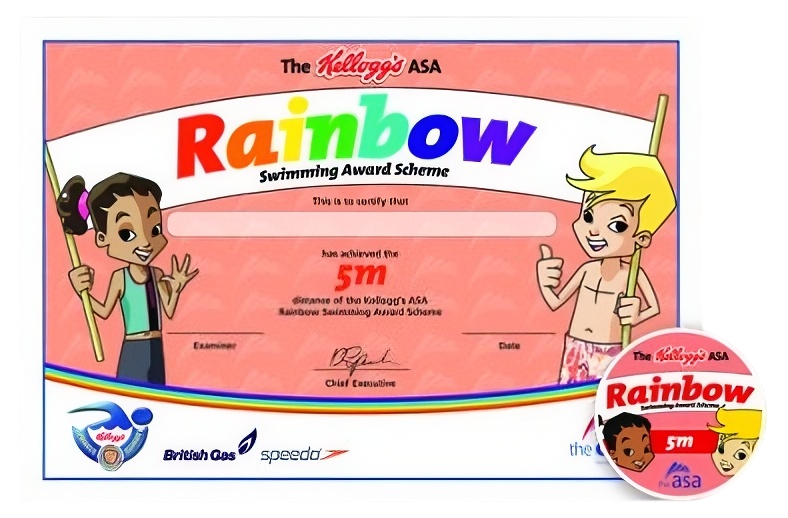
The Rainbow Awards are bright, cheerful and motivating. They are designed to give young swimmers, aged five and older, the incentive to develop their swimming abilities and stamina. This comprehensive collection of distance awards ranges from five metres with a buoyancy aid (Puffin) through to 5,000 metres. This range of awards is designed to motivate children to swim longer distances by increasing the distance gradually over the 19 Awards in the series. This helps young swimmers to develop their confidence, ability and stroke techniques along the way. The Puffin Award and the Rainbow Awards have been very carefully designed to test, encourage and give swimmers the confidence to achieve their goals.

Water Skills Awards

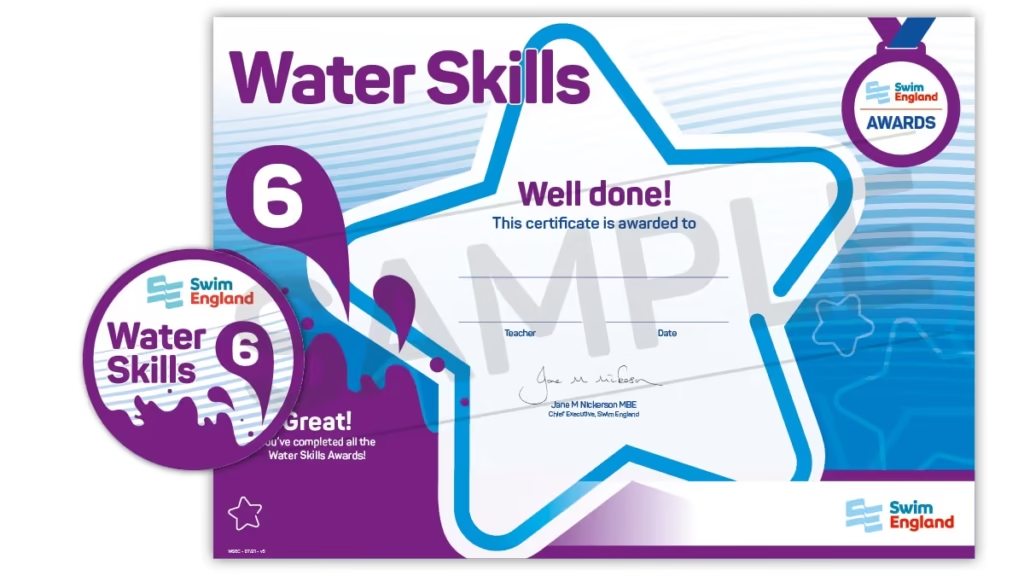
The Swim England Water Skills Awards support intensive activity programmes and reward your child for successfully developing eight out of 10 skills across six grading levels, or six out of eight skills if your child has a disability.

The six Awards are represented by six colour-coded certificates and accompanying badges and focus on confidence, versatility, skills and endurance.

By the time your child succeeds at Water Skills 6, he or she should be able to swim 75 metres within two minutes using three different strokes.

Learn to Swim Stage 1-7 Awards

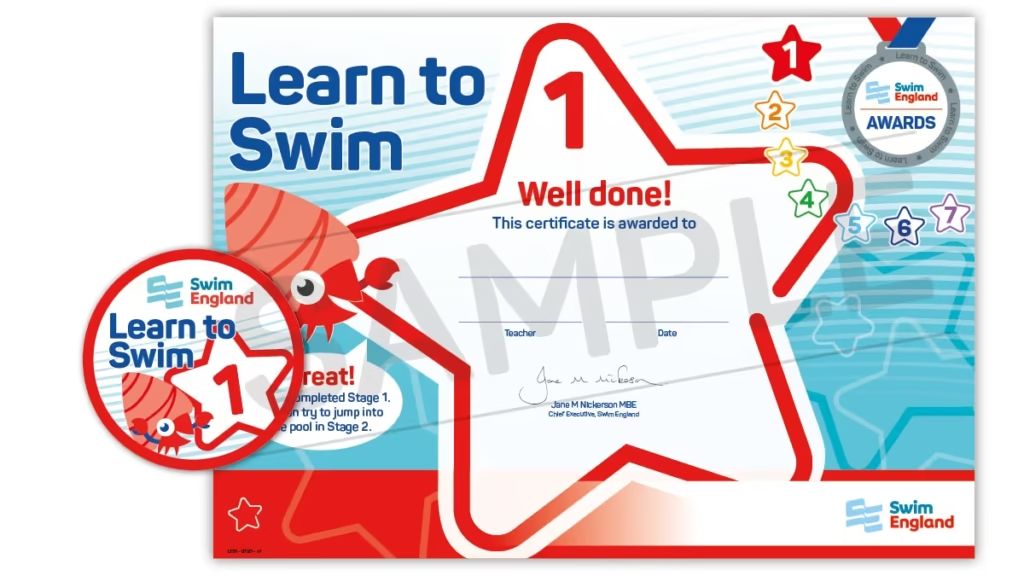
The Learn to Swim Stage 1-7 Awards are divided into progressive stages. They make up the core, national syllabus of learning to swim for primary school aged children.

They are designed to reward your child for their development of the essential aquatic skills they need to be confident, competent and safe in the water.

Each of the Learn to Swim Stage 1-7 Awards has a list of clear outcomes that need to be completed in order to gain each Award.