

Introduction
Choosing children’s swim classes in Ascot is a big decision. It is not about finding something for your child to do every week. You are picking the people who will be in charge of keeping your child safe and helping them feel good about themselves in the water. There are a lot of swim schools in Berkshire, so it is easy to get caught up in looking at class times and costs. You should not forget to ask the important questions.
This guide will help you figure out what makes a children’s swim class in Ascot really good and not just average. It will help you make a decision that you feel good about for your child.
What Parents Should Look For in a Swim School
Before you sign your child up for swimming lessons, take a step back and think about what you want your child to get out of it. A good Swim School should have a programme that includes three things: safety, steady progress, and fun. If any of these things are missing, your child might get bored and not want to keep going.
Here is a list to help you find a Swim School:
- Are the teachers at the Swim School properly trained and checked to make sure they are safe to be around children?
- How many kids are in each class? Are there enough adults in the water to help them?
- Does the Swim School have a plan to help your child learn to swim from beginner to advanced?
- Is the pool warm enough and not too deep for children like yours?
- Do the people who work at the Swim School tell you how your child is doing on a regular basis?
Instructor Qualifications and Experience
When you are looking for someone to supervise a pool session, it is pretty easy to find someone. However, teaching a four-year-old to put their face in the water is a totally different thing.
Qualified teachers are really good at understanding how kids develop. They know how to tell if a kid is feeling confident, and they can change how they are teaching right away.
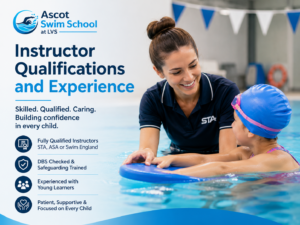
Qualified teachers have skills like understanding child development, knowing how to read a child’s confidence levels, and adapting their approach on the spot. Look for instructors who have qualifications from organisations like the STA, the ASA, or Swim England and who also have up-to-date DBS checks. It is just as important for instructors to have safeguarding training as it is for them to have swimming credentials. A school that has a Designated Safeguarding Officer is showing that they take child protection seriously, and they do not just treat it like something they have to do. You can usually find this information on a school’s About page, along with details of the teaching team, like the teachers and other instructors.
The experience of the teachers is also very important. Teachers who have been working with beginners for a long time tend to be a lot calmer and more patient, and this makes a big difference for kids who are anxious around water. Swimming teachers who have a lot of experience are really good at helping kids who are nervous, and they can make the kids feel much more comfortable in the water.
Class Sizes and Individual Attention
The size of a class is a good way to figure out how good the lessons are. If there are fifteen kids in a class, a child might only get a few minutes of help from the teacher during the class. In a smaller class, the teacher can help the child right away and see the small things they do well, which makes them feel more confident.
For kids who are just starting out, it is really helpful to have a class with someone in the water to assist the teacher. This way, kids can learn faster and better. When you are looking for a class, you should ask how many kids are usually in a beginner class and how many grown-ups are there to supervise.
Water Safety and Child Confidence
When kids are learning how to swim, the first thing they need to feel is confidence in the water. If a kid is scared of the water, they will not be able to learn how to swim well, no matter how good the teacher is. A good class for beginners will help kids feel comfortable in the water first: they will be happy, their shoulders will be relaxed, and they will want to try things.
Learning how to be safe in the water is just as important. Kids need to learn how to get in and out of the pool, what to do if they get into water that is too deep, and how to save themselves if they need to. This is not just about swimming; it is about kids learning how to be safe around water for their whole life. Kids who take swimming lessons should know how to stay safe around water, and that is what swimming lessons should teach them. Swimming lessons should focus on water safety and child confidence, and they are very important for kids.
When You Pick a Swim School
A good swim school has a plan that everyone knows about. This plan is like a map that shows how kids can get better at swimming. Most schools use the Swim England Learn to Swim pathway. It has steps and awards that kids can achieve. This way, parents can see that their kids are really getting better.
You should ask the school how they keep track of progress and how often they check on it. Good schools tell you this clearly at the end of each term. Many schools even put this information on their website, so parents always know what their child is working on next.
Where Your Kid Will Swim
The pool is really important. If the water is too cold, little kids might not want to get in. If the pool has a special entry point that is easy to get in and out of, kids will feel safer.
Look for a pool that is not too cold and has a special area for little kids. Our indoor swimming pool in Ascot provides a comfortable environment where children can learn safely.
It should be easy for them to get in and out of the pool. It is also nice if there is a place for parents to sit and watch their kids. You can check all of this on the school’s website before you sign up.
Before You Enrol Your Child in Swimming Lessons
You should ask some questions before you sign up for a term of swimming lessons.
- You need to know what kind of qualifications the swimming teachers have and if they have up-to-date background checks.
- What is the biggest class size for kids who are just starting out with swimming lessons?
- How will you know how your child is doing with their swimming, and who will tell you about it?
- What if your child is really scared of the water? What will the teachers do to help them?
- Can your child try out a swimming lesson before you pay for a term of lessons?
If the school can answer these questions in a way that makes you feel good, that is a sign that you have found a good school.
Good schools will be happy to talk to you about this if you call them or email them.
Things To Watch Out For When Choosing Swimming Lessons For Your Child
- A lot of parents choose swimming lessons that fit their schedule and are really cheap.
- This makes sense, but it is not always the best idea.
- If you choose a class that is not as convenient but has fewer kids and better teachers, your child will probably learn to swim faster and remember it better.
- Another thing to watch out for is thinking that all beginner classes are the same.
- Some classes are for kids who are really scared of the water, while others are for kids who are already comfortable in the water.
- You should always check what type of class your child will be in before you sign up, so they are not too scared or too bored.
Conclusion
When you are looking for children’s swim classes in Ascot, there are a few things that really matter. You want teachers who are qualified and have experience. The classes should not be too big. Your child needs to know what they are working towards. Most importantly, your child has to feel safe in the water.
You should think about how much it costs and when the classes are. These things are not as important as making sure your child is safe and getting good teaching.
If you take the time to ask questions before you sign up for children’s swim classes, it will be better for your child in the long run. You will not have to switch schools. Your child will have a great start with children’s swim classes.
If you want to learn more about children’s swim classes, you can get in touch with us. We can talk about which class is best for your child based on their age and how confident they are in the water. You can email us at ascotswimschool@gmail.com or contact us at 7458907668.